


Carnivores shape ecosystems — and challenge how we share space. Dr Taylor Shaw, Conservation Scientist at the Endangered Landscapes & Seascapes Programme, explores how monitoring is helping to define what coexistence really looks like.
Carnivores are essential to healthy ecosystems. Through predation and their role in food webs, they help regulate prey populations, support biodiversity, and influence how ecosystems function.
Europe is home to four large carnivores: the wolf, lynx, brown bear and wolverine. These wide-ranging species are sensitive to disturbance and can often be used as indicators of habitat quality and connectivity. Ecologically, they play a powerful role: keeping herbivore populations in check, which can influence vegetation and trigger trophic cascades, as well as leaving carrion for scavengers. Yet all four species have suffered dramatic declines, making their conservation and co-existence in human-dominated landscapes an ongoing research priority.
Meso-carnivores, such as foxes, martens and badgers, are medium-sized predators that sit in the middle of food webs. By feeding on rodents, they help reduce browsing pressure on plants, protect crops, and may even limit the spread of tick-borne disease. Some also disperse seeds or suppress invasive species. Their shorter lifespans and fast generational turnover mean they respond quickly to environmental change — making them valuable candidate indicators of ecological change. Despite their importance, meso-carnivores are an often-overlooked conservation priority: a recent review outlined that over half of small carnivores globally are in population decline, and a quarter are at risk of extinction.
Organisations across Europe are working to conserve large and meso-carnivores alike. The Endangered Landscapes & Seascapes Programme supports large-scale restoration projects, and through dedicated monitoring, these projects are demonstrating the possibilities for carnivore conservation in their landscapes. Each project is monitoring a complex network of plant, prey and predator species, simultaneously documenting the benefits of ecosystem restoration and the important role carnivores play in it.

Understanding bear behaviour in Romania’s Carpathians
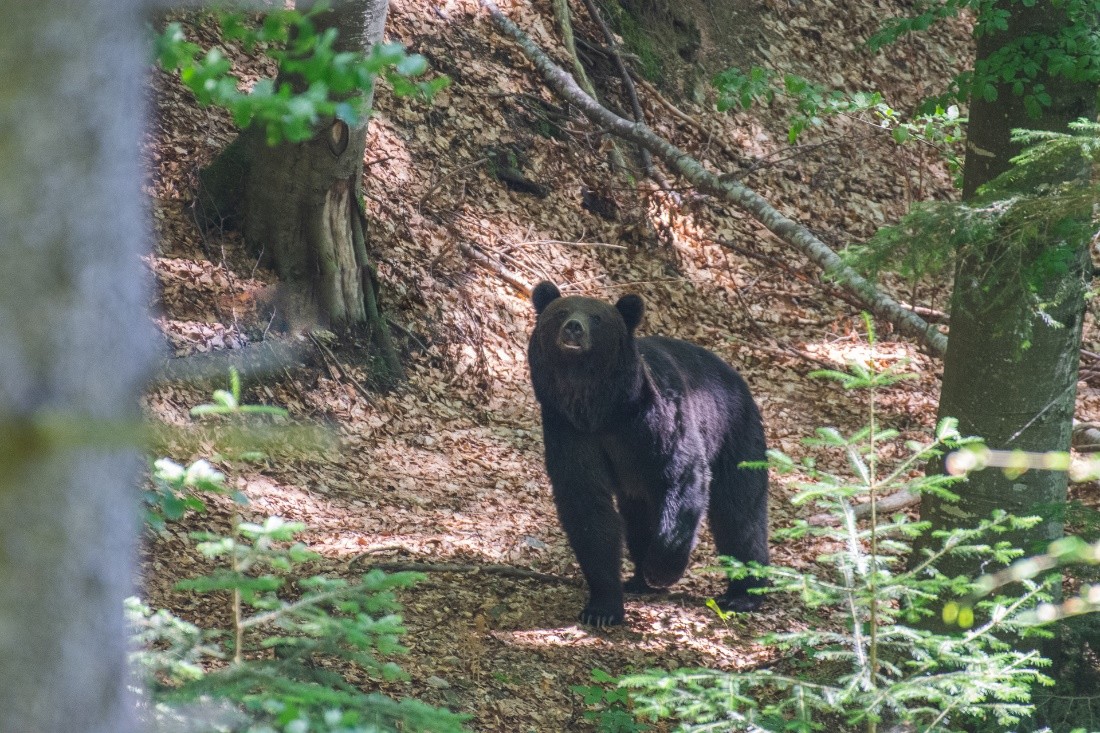
Foundation Conservation Carpathia (FCC) in Romania has been monitoring brown bears in Romania since 2016, when a nationwide ban on trophy hunting came into effect. Using DNA from hair and scat collected in the Carpathian mountains, the team can estimate bear density and monitor population trends over space and time.
Since the ban, public debate around bears has intensified. Some communities and hunting groups believe bear numbers are rising and that incidents have increased. But comprehensive data is limited, and FCC’s monitoring is helping to clarify what is changing — and what may be more a matter of perception than fact. Their findings are now contributing to discussions on long-term bear management policy.
DNA data is also being used to reduce human-bear conflict in villages. A small number of bears, usually males, become accustomed to human presence and begin visiting villages in search of food. FCC’s Rapid Intervention Team responds to these incidents, using light or sound to safely deter the bear. DNA left behind is collected and logged, allowing the team to identify repeat individuals — known as “problem bears” — and track patterns over time.
This data shows that problem bears make up only a small percentage of the population. When identified, the Rapid Intervention Team either relocates these problem bears or, in extreme cases, resorts to lethal control.
Early results suggest that bear visits to villages decline following the removal of a problem individual, though longer-term monitoring is needed to fully assess the impact.
Genetic monitoring is demonstrating that co-existence with bears is possible. A decline in bear incidents in villages is gradually building trust among conservationists, farmers, and local decision-makers — especially when supported by a clear and responsive management system.

FCC shares its data with local authorities and works closely with communities to understand concerns and build trust. Their team provides practical tools — such as electric fencing and livestock guardian dogs — and supports residents in adapting to the presence of bears. This collaborative approach is gradually shifting attitudes and creating space for coexistence.
In one of the last landscapes in Europe still home to a full megafauna community, FCC’s work is showing how science, policy and local knowledge can come together to support both people and wildlife.
Conservation trade-offs for meso-carnivores in the Cairngorms
Cairngorms Connect is the largest restoration network in Britain, working to restore native woodlands, rivers, floodplains, bogs, and montane scrubland within the Cairngorms National Park, Scotland. Its monitoring efforts span a wide range of species and habitats — including carnivores. The largest mammalian carnivores in this food web may surprise you: pine martens, badgers and foxes. No large mammalian carnivores exist in this area; their extirpation occurred centuries earlier due to deforestation and hunting to expand and protect livestock interests. Meso-carnivore populations have also historically been in decline. While legal protection and active management have helped some meso-carnivore populations grow, there are concerns that their recovery may have unintended effects on other species of conservation interest — such as ground-nesting birds like the capercaillie, whose eggs are sometimes taken by meso-carnivores.

Cairngorms Connect is using extensive monitoring to explore how to reconcile these seemingly competing conservation objectives. To investigate this, researchers conducted a large-scale diet analysis of red foxes and pine martens using molecular techniques. They found that both species feed primarily on small rodents, and that prey of conservation concern appeared rarely in their diets — likely as chance encounters.
When primary prey becomes scarce, foxes were found to switch to scavenging more deer carrion. This finding led Cairngorms Connect to set up diversionary feeding stations where supplementary food is left out for carnivores to eat. Artificial nests were also installed nearby to test whether this additional food could reduce nest predation.
This approach is based on the satiation hypothesis: if meso-carnivores are well-fed, will they be less likely to search for other food sources, such as capercaillie nests?

Results suggest the answer is yes. Diversionary feeding almost halved the predation rates of pine martens and badgers on artificial nests, and predicted nest survival increased by over 80%. Alongside this, researchers monitored real capercaillie nests over three years and found that hens in areas with diversionary feeding were significantly more likely to raise broods. These findings offer promising evidence that targeted feeding can benefit this important species.
Much of the supplementary food comes from red and roe deer culled to support native woodland regeneration. By using deer remains left on site, the project connects habitat restoration, deer management, and carnivore support — revealing potential ‘triple wins’ for forests, meso-carnivores, and species like the capercaillie.
Tracking wolf movements across Polesia’s wild landscapes
Polesia – Wilderness without borders is a landscape restoration project focused on the Ukrainian part of Polesia — a vast lowland region shaped by the Pripyat River and home to rich wetlands, forests, and threatened species including bison, lynx and wolves.
Up to February 2022, research linked to the project took place in the broader Polesia region, including studies in the Białowieża Forest Complex — Europe’s largest remnant of old-growth woodland, located on the border between Poland and Belarus.

As part of this work, ten wolves were fitted with GPS collars and tracked for up to ten months. The data helped researchers map home ranges and examine how wolves use different parts of the landscape.
The study showed that wolves strongly preferred protected areas, avoiding roads and open landscapes during the day and becoming more active at night. As they are hunted outside reserves, these areas act as key refuges — not only for wolves, but also for prey such as bison, moose and wild boar. Camera traps confirmed a clear pattern of nocturnal activity, suggesting wolves adjust their behaviour to avoid humans and highlighting the value of undisturbed protected areas in conservation planning.
These findings reinforce the value of giving wolves space — allowing them to avoid conflict, rather than forcing coexistence.

Carnivore monitoring for decision making
These projects show how carnivore monitoring can support both ecological recovery and informed decision-making. By tracking species interactions, measuring conservation outcomes, and testing approaches like land-sharing and land-sparing, they offer practical insights for managing restored landscapes. As the work continues, the data being collected will help shape policy, guide future restoration, and demonstrate that coexistence with carnivores is not only possible — but part of a thriving, multi-use landscape.


